On this page
- What is L-theanine, and why is it linked to calm and focus?
- Does L-theanine actually reduce stress?
- Does it improve focus, or is the caffeine combo the real story?
- Can L-theanine help you sleep?
- Is L-theanine safe, and who should be careful?
- Do you even need a supplement, or is the tea in your cup enough?
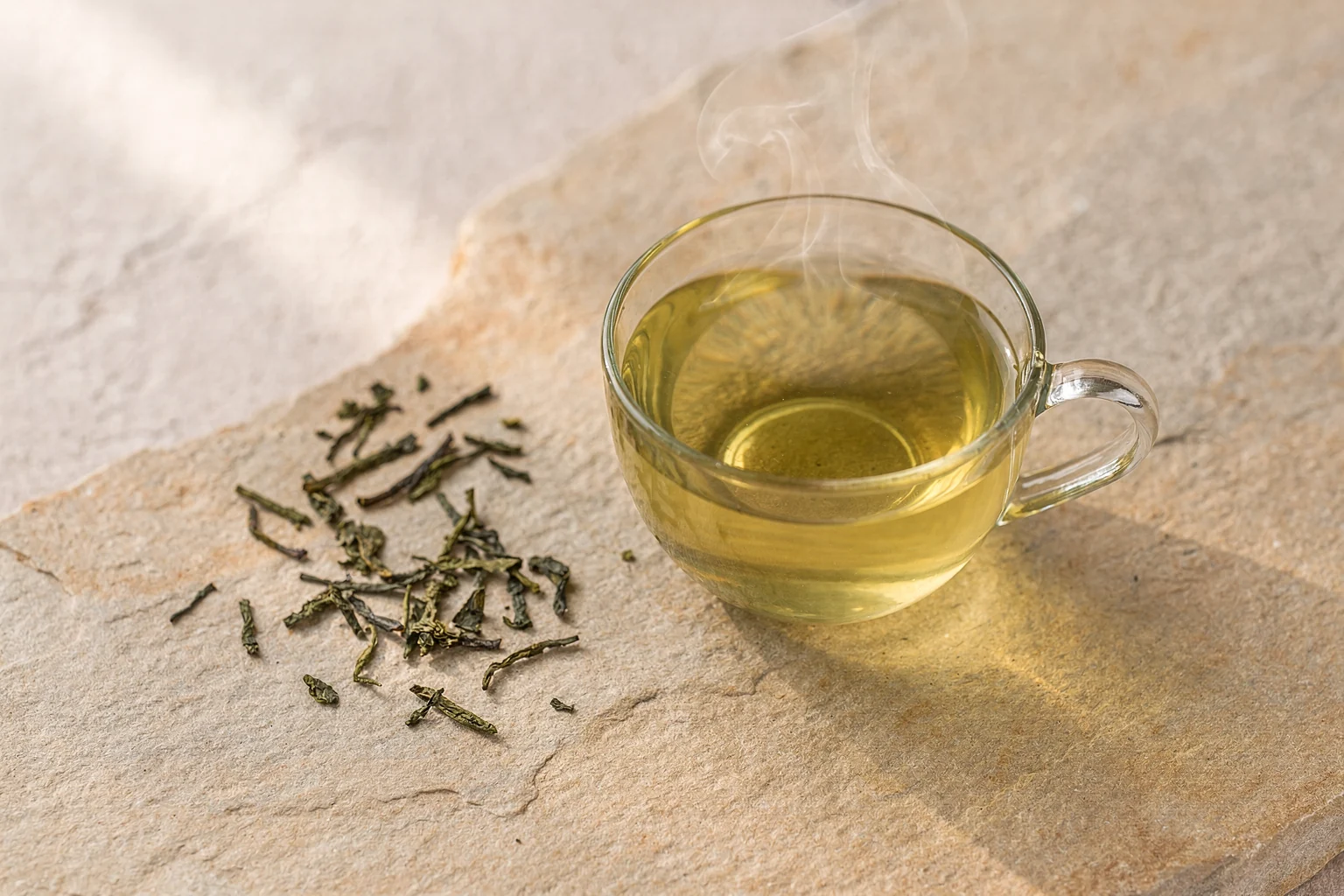
L-theanine is an amino acid found in tea that promotes alpha brain waves, the pattern of a calm but alert mind. In healthy adults the human evidence points to modest, real benefits: a calmer feeling over a few weeks, and sharper attention mainly when it is paired with caffeine. It is generally well tolerated. But the science is still preliminary, and L-theanine is not a treatment for a diagnosed anxiety disorder.
This page is a spoke in our cluster on stress, cortisol and sleep, which itself sits under the pillar guide, why am I always tired? L-theanine sits next to the explainers on magnesium glycinate, ashwagandha and melatonin as one of the calm-and-sleep compounds people reach for. It is unusual among them for one reason: you already drink it. L-theanine is the amino acid in the tea in your cup, which makes it the rare supplement worth checking against a brew before a bottle. This page grades it plainly, the biology that is solid, the human evidence that is thinner than the marketing suggests, and whether a capsule beats a cup.
- L-theanine is the calm compound in tea. It is an amino acid in green and black tea, and Cleveland Clinic links it to alpha brain-wave activity and a state of calm, focused relaxation.
- Its strongest evidence is with caffeine, not alone. One trial found 100 mg of L-theanine plus 50 mg of caffeine improved accuracy and attention more effectively than caffeine alone.
- It takes the edge off coffee. Reviews report that L-theanine offsets the vasoconstriction, the blood-vessel narrowing, that caffeine causes, which is the biology behind the smoother, less jittery feeling.
- The stress evidence is modest and slow. A 2019 randomised trial, 200 mg a day for four weeks in 30 healthy adults, found lower stress and sleep-quality questionnaire scores with no adverse events.
- The hype runs ahead of the data. A 2024 review calls the evidence promising but far too preliminary, with no gold-standard sleep trials. You already get about 6 to 32 mg in a cup of tea.
What is L-theanine, and why is it linked to calm and focus?
L-theanine is a non-protein amino acid found mostly in tea leaves and a few mushrooms. Once absorbed, L-theanine reaches the brain and is associated with increased alpha brain-wave activity, the electrical pattern of a mind that is relaxed but still alert. That is the whole basis of its reputation: it appears to encourage calm without sedation, a state better described as relaxed alertness than as drowsiness.
Cleveland Clinic describes L-theanine as an amino acid found mostly in tea leaves that is linked to changes promoting alpha brainwave activity, which is associated with a state of calm, focused relaxation. The dose people take from a bottle is far larger than a single cup delivers: most human studies use roughly 200 to 400 mg a day, while a 200 ml cup of brewed tea supplies only a fraction of that. The amino acid is the same either way, which is exactly why the tea-versus-pill question is a fair one to ask.
Does L-theanine actually reduce stress?
Modestly, and over weeks rather than minutes. In healthy adults, taking L-theanine daily is associated with lower scores on validated stress and sleep-quality questionnaires, but the effect is gentle and builds gradually, not the instant calm the labels imply. It supports a sense of relaxation; it does not switch off a stressful day, and it is not a substitute for managing the load itself.
The clearest human trial is a 2019 randomised, double-blind, placebo-controlled crossover study in the journal Nutrients. It gave 30 healthy adults 200 mg of L-theanine a day for four weeks and found that their stress-related and sleep-quality questionnaire scores fell significantly versus placebo, alongside improvements in verbal fluency and executive function, with 100% of participants completing and no adverse events reported. Cleveland Clinic is careful to frame this honestly: L-theanine may support relaxation and stress reduction, but larger studies are needed to confirm the findings. Crucially, none of this makes it a clinical treatment. L-theanine is not a first-line treatment for a diagnosed anxiety disorder, which is a medical matter for a qualified professional, not a supplement.
The available data on the biological properties of l-theanine are promising, but far too preliminary to unequivocally support many of the purported health claims. Dashwood & Visioli, Nutrition Research, 2024
Does it improve focus, or is the caffeine combo the real story?
The caffeine combination is the real story. On its own, L-theanine's effect on focus is inconclusive, but paired with caffeine the evidence gets much stronger. L-theanine appears to smooth caffeine's rough edges while keeping its alertness, which is why the two are so often sold and studied together as a calm-focus pairing rather than as a standalone nootropic.
A 2024 review found that 100 mg of L-theanine plus 50 mg of caffeine improved accuracy and attention more effectively than caffeine alone, and that the combination circumvented the vasoconstrictor effects of caffeine, the blood-vessel narrowing behind the jittery feeling. Caffeine itself works largely by blocking adenosine, the brain's build-up-of-tiredness signal, so pairing it with L-theanine keeps the wake-up push while softening the tension. A 2025 double-blind crossover trial in 37 sleep-deprived young adults pushed the dose higher, 200 mg of L-theanine with 160 mg of caffeine, and found it sharpened selective attention, improving reaction time by about 52 milliseconds versus roughly 14 for placebo. The honest caveat: gains show up on some attention tasks and not others, so this is a useful nudge, not a cognitive transformation.
| What the marketing says | What the human evidence shows |
|---|---|
| Instant calm and stress relief | A 4-week trial found lower stress and sleep scores in healthy adults; the effect is modest and builds over weeks, not minutes |
| Laser focus on its own | Focus benefits from L-theanine alone are inconclusive; the clearest attention gains appear only when it is paired with caffeine |
| Takes the jitters out of coffee | Supported: reviews find L-theanine offsets caffeine's vasoconstriction and smooths its edge |
| A natural sleep aid | It has not been shown to induce sleep directly; it may aid relaxation before bed, but there are no gold-standard sleep trials |
| A proven anxiety treatment | Not established; L-theanine is not a first-line treatment for a diagnosed anxiety disorder |
Can L-theanine help you sleep?
Possibly, but indirectly, by easing you toward relaxation rather than knocking you out. L-theanine has not been shown to induce sleep directly; any benefit seems to come from a calmer, less wired state before bed. That makes it different from a sedative, and it will not override a late coffee, a bright bedroom or a racing mind, the foundations we cover in the stress, cortisol and sleep guide.
The honest state of the science is thin here. The 2024 review notes there are, to date, no gold-standard randomised, placebo-controlled trials examining the effects of L-theanine on sleep induction and maintenance. What exists is suggestive: in the 2019 trial, the sleep-quality subscales for how quickly people fell asleep and how disturbed their sleep was improved on L-theanine versus placebo. If sleep is your main concern, that puts L-theanine below the better-studied levers. Our companion pieces on magnesium glycinate and melatonin in Malaysia weigh those options, and the boring foundations still beat any capsule.
Is L-theanine safe, and who should be careful?
For most healthy adults over the short term, L-theanine appears well tolerated. Reported side effects are usually mild, and the four-week 2019 trial recorded no adverse events at 200 mg a day. It is not, however, free of interactions, and reassuring short-term data is not the same as a clean long-term record, because the studies simply have not run long enough to say.
Cleveland Clinic notes the mild side effects can include drowsiness and headaches, and flags that L-theanine may interact with medicine, especially blood pressure medications and sedatives, potentially increasing their effects. That matters because L-theanine can gently lower blood pressure, so stacking it with medication that does the same is a real reason to check with a professional first. Anyone who is pregnant or breastfeeding, taking regular medication, or managing a health condition should speak to a healthcare provider before starting. And because a supplement is not pre-approved for effectiveness the way a medicine is, product quality varies, which brings us to the Malaysian buyer's checkpoint.
Do you even need a supplement, or is the tea in your cup enough?
For a nation of tea drinkers, this is the practical heart of it: you are already getting L-theanine, and a cup or two delivers a meaningful amount without a bottle. A 200 ml cup of brewed tea supplies roughly 6 to 32 mg, so a couple of unhurried cups of green tea sits in a sensible everyday range, with the added calm of the ritual itself. A concentrated capsule reaches the higher study doses faster, but the 2024 review is clear that the science does not yet match the hype behind this trending supplement.
If you do choose a supplement in Malaysia, the same checkpoint applies as for any product here. The National Pharmaceutical Regulatory Agency (NPRA) requires registered products to carry a MAL registration number on the label, and treats products without proper security labelling as unregistered. Registration checks manufacturing and labelling standards, not whether the product calms you, so a MAL number tells you the product is properly on the market, not that the headline claim is true. The sensible order of operations is the same one the rest of this cluster reaches: fix the foundations first, treat L-theanine as a mild, pleasant support rather than a fix, and if you are worried about persistent stress or poor sleep, a short conversation with someone who reads the studies will get you further than another bottle.
Frequently asked questions
Does L-theanine make you sleepy?
Not usually in the way a sedative does. L-theanine is linked to alpha brain waves and a state of calm, focused relaxation rather than drowsiness, and Cleveland Clinic notes it has not been shown to induce sleep directly. Some people do feel more settled before bed, and mild drowsiness is a listed side effect, but its reputation is for relaxed alertness, not knocking you out.
How much L-theanine should you take?
Most human studies use about 200 to 400 mg a day for a few weeks, and the clearest stress trial used 200 mg daily. Higher doses up to 900 mg have been studied, but long-term safety is not established. There is no official recommended intake because L-theanine is not an essential nutrient. If you take medication, especially for blood pressure, check with a healthcare professional before starting.
Can you take L-theanine with coffee?
This is where the evidence is strongest. A 2024 review found 100 mg of L-theanine with 50 mg of caffeine improved attention more than caffeine alone, and that L-theanine offset caffeine's vasoconstriction, the blood-vessel narrowing behind the jitters. Many people pair the two for a calmer, steadier focus. It smooths caffeine's edge rather than replacing the need for good sleep.
Is L-theanine safe to take every day?
For most healthy adults over a few weeks it appears well tolerated, with mild side effects such as drowsiness or headache, and a 2019 trial reported no adverse events at 200 mg a day. Long-term daily safety is not well studied, and L-theanine may increase the effects of blood pressure medicines and sedatives. Anyone pregnant, breastfeeding, on medication or managing a condition should ask a professional first.
Do you get enough L-theanine from drinking tea?
You get a meaningful amount. A 200 ml cup of brewed tea supplies roughly 6 to 32 mg of L-theanine, so a couple of cups of green tea is a sensible everyday source, with the calm of the ritual on top. A supplement reaches the higher study doses faster, but a 2024 review concluded the science does not yet match the hype, so tea first is a reasonable stance.
Is L-theanine a treatment for anxiety?
No. L-theanine is not a first-line treatment for a diagnosed anxiety disorder, which is a medical condition for a qualified professional to assess and manage. The human evidence is for a modest, general sense of calm in healthy adults, and a 2024 review calls even that promising but far too preliminary. If anxiety is affecting your daily life, please speak to a doctor rather than relying on a supplement.
References
- L-Theanine: Benefits, Uses and Side Effects (Cleveland Clinic) — supports that L-theanine is a tea-leaf amino acid linked to alpha brain waves and calm, focused relaxation; typical 200-400 mg doses; mild side effects (drowsiness, headaches); interactions with blood pressure medication and sedatives; not shown to induce sleep directly.
- Effects of L-Theanine Administration on Stress-Related Symptoms and Cognitive Functions in Healthy Adults: A Randomized Controlled Trial (Hidese et al., Nutrients, 2019) — supports the 200 mg/day, 4-week trial in 30 healthy adults; lower stress and PSQI sleep-quality scores; improved verbal fluency and executive function; no adverse events.
- l-theanine: From tea leaf to trending supplement, does the science match the hype for brain health and relaxation? (Dashwood & Visioli, Nutrition Research, 2024) — supports the 6-32 mg per 200 ml cup content; the 100 mg L-theanine + 50 mg caffeine attention finding; caffeine vasoconstriction offset; no gold-standard sleep trials; and the promising-but-preliminary conclusion.
- High-dose L-theanine-caffeine combination improves selective attention in acutely sleep-deprived young adults (British Journal of Nutrition, 2025) — supports the 200 mg L-theanine + 160 mg caffeine combination in 37 sleep-deprived adults improving selective attention accuracy and reaction time (~52 ms vs ~14 ms).
- Product Registration FAQ (National Pharmaceutical Regulatory Agency, Malaysia) — supports that registered products must display a MAL registration number and that products without proper security labelling are treated as unregistered.