On this page
- What is creatine, and how does it actually make energy?
- Creatine for energy and healthy ageing: just for muscle, or does it help everyday tiredness too?
- Creatine, muscle and ageing: the strongest evidence
- What about bone strength and falls?
- Does creatine help the brain as we age?
- Who tends to benefit most from creatine?
- How much creatine, is it safe, and what about the kidney and ‘water weight’ worries?
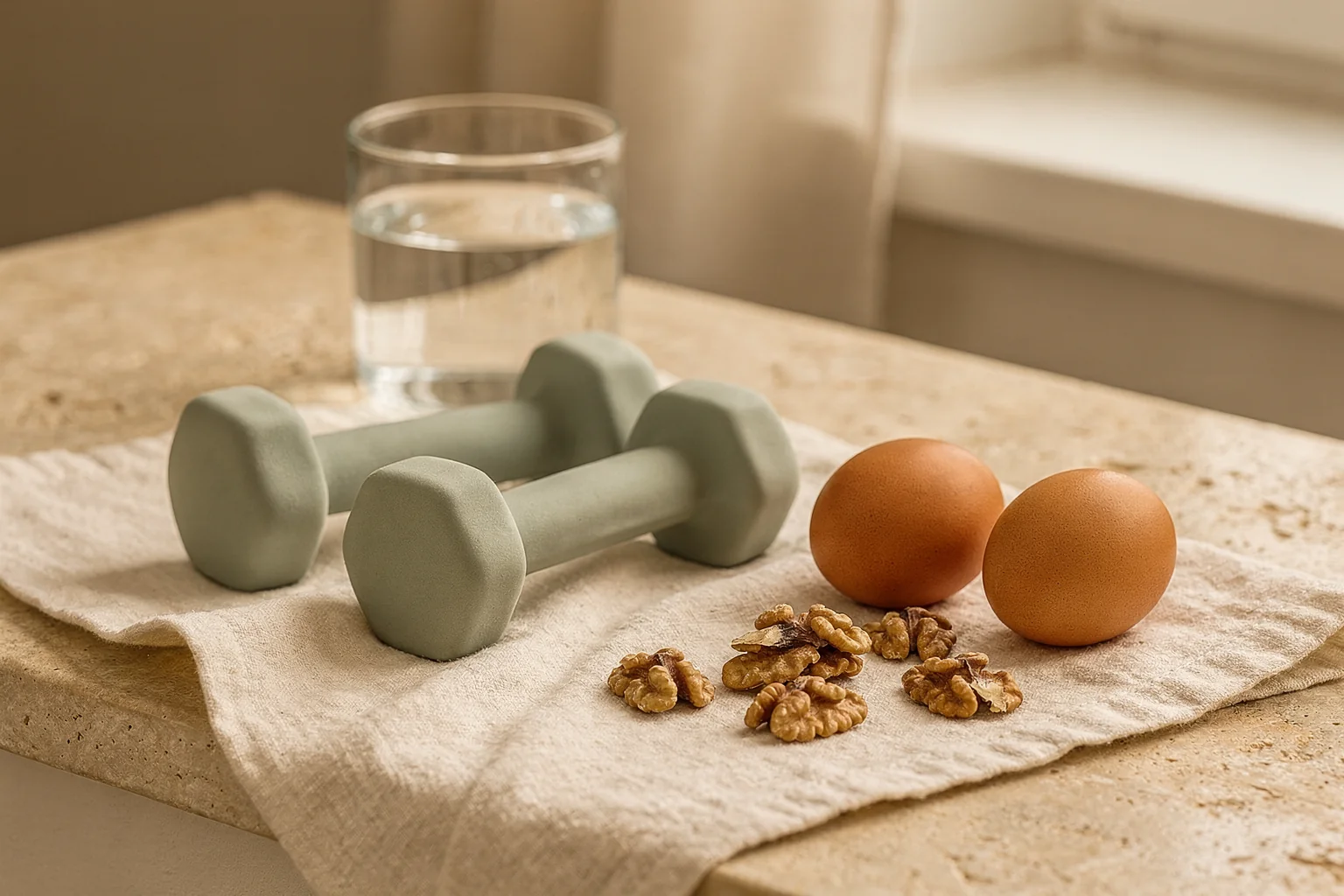
Creatine is not just for building muscle. It helps your cells regenerate ATP, the molecule that powers everything you do, so it plays a genuine role in energy. The strongest evidence is for preserving muscle and strength as you age (paired with resistance exercise); the evidence for brain and cognition is promising but still early.
Creatine has spent decades typecast as a powder for young men chasing bigger muscles. That reputation is now badly out of date. Creatine is one of the most studied supplements in the world, it sits at the centre of how your cells make energy, and the research that has grown fastest is about something most gym marketing ignores: healthy ageing. This page lays out, calmly and with sources, where the evidence is strong, where it is merely promising, and where it has been oversold.
This is one spoke of a bigger picture. If you are reading this because energy feels harder to come by than it used to, start with the parent guide on cellular energy and healthy ageing, which sits under the pillar why am I always tired — because creatine is one piece of a much larger answer that includes sleep, nutrient status and how you move.
- It is an energy molecule, not just a muscle one. Creatine recharges ATP through the phosphocreatine system; about 95% of your creatine is in muscle and roughly 5% in high-energy tissues including the brain.
- The muscle-and-ageing evidence is the strongest. Combined with resistance training, creatine helps older adults gain lean mass and strength — supporting the muscle that tends to decline with age (sarcopenia).
- The brain evidence is promising but early. A 2026 review found 5 of 6 studies linked creatine to better cognition in older adults (memory and attention), but the authors stress the evidence is still limited.
- Some people stand to benefit more. Women, vegetarians and vegans, and older adults tend to start with lower creatine stores.
- It is well studied and generally safe. Creatine monohydrate is the most-researched form; in healthy people it does not harm the kidneys, and the main early effect is a little water weight.
What is creatine, and how does it actually make energy?
Creatine is a compound your body already makes and also gets from food, and its job is to help recharge cellular energy. Inside your cells, energy is spent as ATP (adenosine triphosphate); creatine, stored as phosphocreatine, donates a phosphate to rebuild ATP almost instantly during short, intense efforts. More phosphocreatine means a faster energy top-up.
This is not a niche role. According to a 2024 review in Frontiers in Physiology, phosphocreatine plays a pivotal role in sustaining ATP, with about 95% of the body's creatine stored in skeletal muscle and the remaining ~5% in high-energy-demand tissues including brain cells. Your body makes creatine from three amino acids and tops it up from meat and fish, so omnivores carry a reasonable baseline. Creatine works alongside the other parts of your cellular energy machinery, including CoQ10, which your mitochondria use to turn food into energy. The interesting question is what happens when you raise those stores further, and in whom that actually matters.
Creatine for energy and healthy ageing: just for muscle, or does it help everyday tiredness too?
It is fairer to say creatine supports the systems behind energy than to claim it is a stimulant. Creatine does not work like caffeine; it will not give you a jolt. What it does is improve your capacity to produce energy for short, hard efforts and support the muscle you use to move through a day — which is a different, slower kind of ‘energy’.
The honest framing matters because the marketing often is not honest. Unlike caffeine, which simply blocks your brain's tiredness signal, creatine adds nothing you can feel in the first hour. Its contribution to feeling less drained is indirect: by helping you preserve strength and muscle as you age, it helps you stay active, and staying active is one of the most reliable defences against everyday fatigue. The table below sorts the popular claims from the supported ones.
| The popular claim | What the evidence actually supports |
|---|---|
| “Creatine is only for bodybuilders.” | No — it is studied across older adults, women, vegetarians and clinical groups, not just athletes. |
| “It gives you an energy boost like a pre-workout.” | Not as a stimulant. It speeds ATP regeneration for short, intense efforts; you won't ‘feel’ it like caffeine. |
| “It builds muscle on its own.” | No — the muscle and strength gains in older adults come when it is paired with resistance training. |
| “It sharpens the brain.” | Promising but early — a 2026 review found a positive signal for memory and attention, on limited evidence. |
Creatine, muscle and ageing: the strongest evidence
The best-supported reason to care about creatine after 40 is muscle. From your 30s onward you slowly lose muscle and strength as part of normal ageing, and creatine — when combined with resistance exercise — is one of the few supplements with real evidence for helping to offset that. The key words are ‘combined with resistance exercise’; on its own it does little.
The International Society of Sports Nutrition's position stand reports a meta-analysis of 405 elderly participants (mean age 64) who experienced greater gains in muscle mass and upper-body strength with creatine during resistance training, and concludes that creatine supplementation “can help prevent sarcopenia and bone loss in older individuals.” Sarcopenia — the age-related loss of muscle mass and strength — is not a rare problem here. A 2025 study of older adults in Selangor found that, among 469 people aged 60 to 88, 10.0% had confirmed sarcopenia and 38.4% had possible sarcopenia, and those with sarcopenia were far more likely to suffer falls. That is the real-world stakes behind ‘muscle as you age’: it is about staying steady on your feet and independent, not vanity.
Two practical points follow. First, the supplement is the junior partner: the resistance training does the heavy lifting, and creatine helps you get a bit more from it. Second, this is exactly the kind of change worth discussing with a real person rather than acting on a TikTok clip — because the right first step is usually ‘start resistance training safely’, not ‘buy a tub of powder’.
What about bone strength and falls?
Bone is the quieter half of the same story, and it matters because falls are what turn lost muscle into lost independence. Beyond muscle, the evidence suggests creatine paired with resistance training may also help protect bone in older adults — which is relevant precisely because weaker muscle and bone together raise the risk of a fall.
The connection is direct in the Malaysian data. In that Selangor study, people with confirmed or severe sarcopenia had roughly ten times the odds of falling than those without, and were similarly more likely to lose the ability to manage daily activities independently — so anything that helps preserve muscle and bone strength is really about staying steady and self-sufficient. The ISSN position stand notes that creatine can help prevent sarcopenia and bone loss in older individuals when used alongside training, and a 2025 review highlights its possible value around menopause for the alteration of bone tissue. As ever, the training is doing the real work; creatine is a supporting role, not a stand-alone shield against fractures.
Does creatine help the brain as we age?
This is the area generating the most excitement and the most overstatement, so read it carefully: the brain signal is real but early. Because the brain is an energy-hungry organ that also relies on the creatine–phosphocreatine system, it is biologically plausible that topping up creatine could support cognition — and some studies now point that way, especially in older adults and under stress.
A 2026 systematic review in Nutrition Reviews looked specifically at older adults. Across six studies (1,542 participants, 55.7% female, aged 55+), five of the six (83.3%) reported a positive relationship between creatine and cognition, particularly in memory and attention. Crucially, the same authors are blunt about the limits: “The current limited evidence suggests that creatine may be associated with benefits for cognition in generally healthy older adults. However, high-quality clinical trials are warranted.” In plain terms: a promising signal worth watching, not a settled brain booster. The Frontiers review similarly notes cognitive improvements after creatine mostly in demanding conditions such as sleep deprivation, where brain energy is under strain — which is a long way from ‘creatine makes you smarter’.
Who tends to benefit most from creatine?
If your stores are already full, extra creatine does less; the people who respond most are those who start lower. That includes women, vegetarians and vegans, and older adults — groups whose baseline creatine tends to be lower either because they make or eat less of it.
A 2025 narrative review spells out the differences. Women's bodies make less of their own creatine — endogenous creatine synthesis in women runs at around 70–80% of the rate reported in men — and the same review notes creatine “could be useful to counteract some of the physiological changes linked to the menopausal process, such as the alteration of bone tissue.” Diet matters too: creatine comes mainly from meat, fish and poultry, so vegans have virtually no dietary source and vegetarians and vegans, starting from lower stores, may see a more pronounced improvement from supplementing. None of this means everyone should rush out and buy it — it means the benefit is most likely where the starting point is lowest, which is a useful thing to know about yourself before spending a ringgit.
How much creatine, is it safe, and what about the kidney and ‘water weight’ worries?
For healthy adults, creatine is one of the better-studied supplements for safety, and the scare stories are mostly myths. The most common, well-evidenced effect is a small, temporary gain in water weight in the first week — not fat, and not harmful. The kidney fear is not supported in healthy people.
On dose, the ISSN position stand describes two simple options: a faster loading approach of about 5 g four times a day for 5–7 days, or simply 3–5 g a day, with creatine monohydrate the most extensively studied and clinically effective form; it adds that consuming about 3 g a day may be worthwhile particularly as one ages. On safety, the same body states that short- and long-term supplementation (up to 30 g/day for 5 years) is safe and well-tolerated in healthy individuals, from infants to the elderly, and that there is no compelling evidence it negatively affects kidney function in healthy or clinical populations. The familiar ‘water weight’ is benign: Harvard Health notes that some people retain a couple of pounds of fluid in the first week, but this is temporary.
What this tends to mean in practice: for a healthy older adult who is already moving and lifting, a steady 3–5 g a day of plain creatine monohydrate is a low-risk, evidence-backed thing to consider — but the order of operations matters. Movement, sleep, protein and your basic nutrient status come first; creatine is a sensible add-on, not a substitute. If you are not sure whether it fits your situation, that is exactly the kind of personal question a calm, no-pressure chat can help you think through.
Frequently asked questions
Is creatine only useful if I go to the gym?
For the muscle and strength benefits, largely yes — the gains in older adults come when creatine is paired with resistance training, not from the powder alone. There may be separate, early-stage benefits for the brain that don't depend on exercise, but those are less established. If you are not doing any resistance exercise, the most useful first step is usually to start that safely, not to buy a supplement.
Does creatine give you energy like coffee?
No. Creatine is not a stimulant and you won't feel a buzz. It works behind the scenes by helping your cells regenerate ATP for short, intense efforts and by supporting the muscle you use every day. That is different from caffeine, which simply blocks your brain's tiredness signal. Think slow, structural support for energy, not a quick lift.
Is creatine safe for older adults and for women?
In healthy people it is one of the more reassuringly studied supplements. The International Society of Sports Nutrition reports that supplementation up to 30 g/day for 5 years is well-tolerated in healthy individuals from infants to the elderly, with no compelling evidence of harm to kidney function. Women may actually be good candidates, as they tend to start with lower creatine stores. ‘Safe for healthy adults’ is not ‘safe for everyone’: anyone with kidney problems, or who is pregnant or on medication, should check with a doctor first.
Will creatine make me put on weight?
You may gain a little weight in the first week, but it is water held inside the muscle, not fat. As Harvard Health notes, this fluid gain is temporary. Over time, any change in body composition tends to reflect the muscle you build through training, not the creatine itself.
Which form of creatine should I look for, and how much?
Plain creatine monohydrate is the form with by far the most evidence and is also the cheapest — the fancier ‘new and improved’ versions rarely justify their price. The ISSN describes either a short loading phase or simply 3–5 g a day of monohydrate. Check the elemental creatine amount on the label, and ask a pharmacist if you take other medication.
Can creatine prevent or cure age-related muscle loss?
It is not a cure for anything, and no supplement is. What the evidence supports is that creatine, alongside resistance training, can help offset some age-related muscle and strength loss (sarcopenia) — a contribution, not a guarantee. Persistent weakness, unexplained muscle loss or frequent falls are reasons to see a doctor, not to rely on a supplement.
References
- International Society of Sports Nutrition position stand: safety and efficacy of creatine supplementation in exercise, sport, and medicine (JISSN, 2017) — dosing (5 g ×4/day loading, or 3–5 g/day; ~3 g/day with ageing), safety up to 30 g/day for 5 years, no compelling renal harm in healthy people, monohydrate most studied, helps prevent sarcopenia and bone loss; meta-analysis of 405 elderly.
- Creatine and Cognition in Aging: A Systematic Review of Evidence in Older Adults (Nutrition Reviews, 2026;84(2):333–344) — 6 studies, 1,542 participants (55.7% female), aged 55+; 5 of 6 (83.3%) reported a positive link to cognition, particularly memory and attention; authors stress evidence is limited and high-quality trials are warranted.
- The power of creatine plus resistance training for healthy aging (Frontiers in Physiology, Bonilla et al., 2024) — phosphocreatine sustains ATP; ~95% of creatine in muscle, ~5% in high-energy tissues including brain; cognition benefits chiefly under stress such as sleep deprivation; benefits require pairing with resistance training.
- Creatine Supplementation Beyond Athletics: Benefits of Different Types of Creatine for Women, Vegans, and Clinical Populations (narrative review, 2025) — women's endogenous synthesis ~70–80% of men's; possible menopause/bone relevance; creatine comes mainly from meat, fish and poultry, so vegans/vegetarians start lower and may respond more; monohydrate most evidenced.
- Prevalence and risk factors of sarcopenia and its effect on functional status and falls among the elderly in Selangor (PeerJ, 2025) — 469 adults aged 60–88, AWGS 2019: confirmed sarcopenia 10.0%, possible sarcopenia 38.4%; sarcopenia strongly associated with falls and loss of independence.
- What is creatine? Potential benefits and risks of this popular supplement (Harvard Health Publishing) — a couple of pounds of fluid may be retained in the first week but this is temporary; people with kidney disease should consult a doctor first.