On this page
- What is ashwagandha, and why do people take it for stress?
- Does ashwagandha actually lower stress and cortisol?
- Does ashwagandha help with energy or fatigue, not just stress?
- Is ashwagandha safe, and who should avoid it?
- Is ashwagandha regulated in Malaysia, and how do you check a product is registered?
- How much ashwagandha, and which form was actually studied?
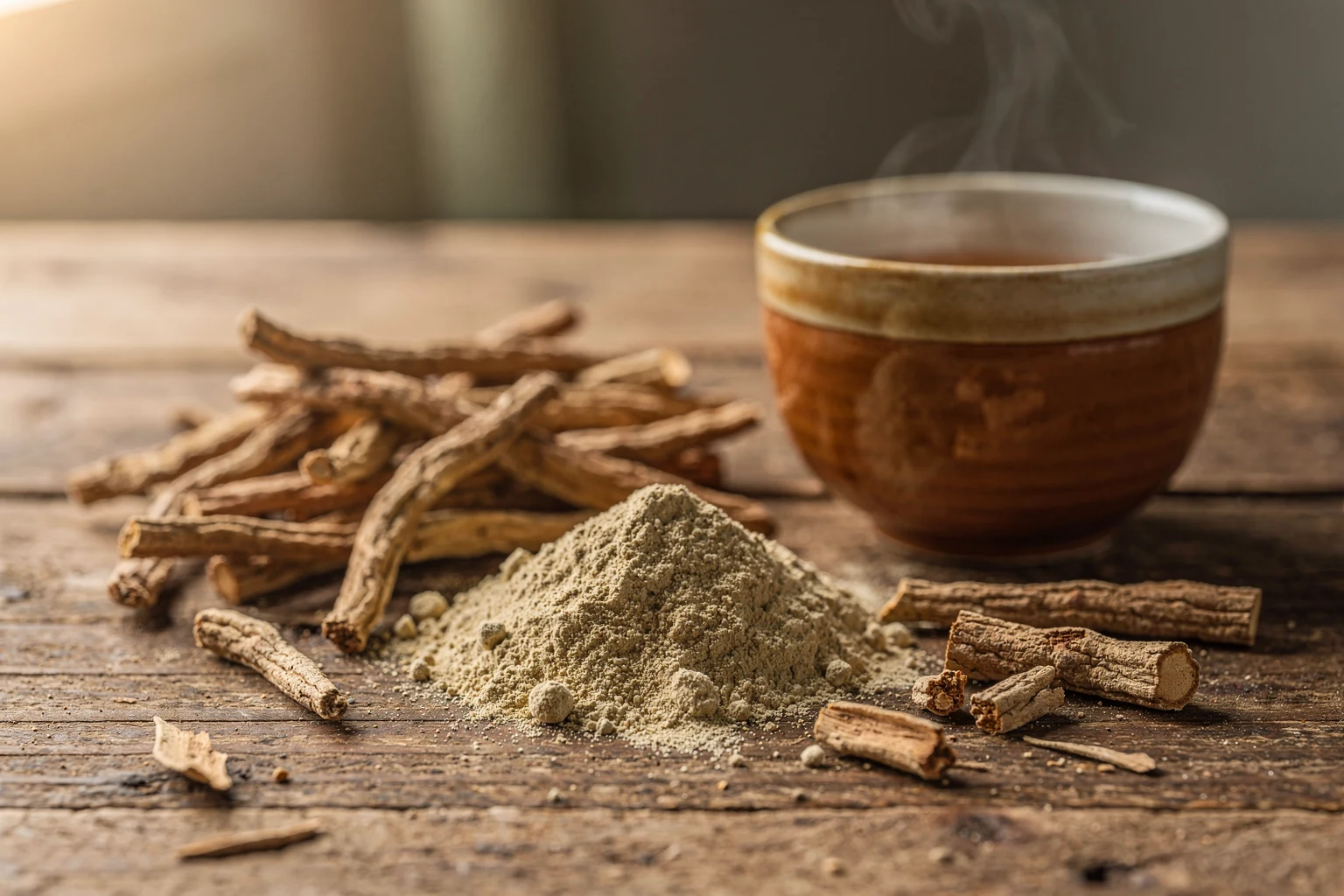
Ashwagandha (Withania somnifera) is a traditional Ayurvedic root extract now sold across Malaysia as a stress-relief supplement. Randomised trials consistently show it lowers cortisol; results on self-reported stress and anxiety scores are real but less consistent. It is generally well tolerated short-term, though rare liver-injury cases exist, and in Malaysia it is regulated as a traditional product requiring NPRA registration.
This page sits next to two others in the same cluster: the CortisolTok myth, which untangles what cortisol actually does, and melatonin's legal status in Malaysia, which covers a hormone Malaysia restricts under the Poisons Act. Ashwagandha is a different story. It is not a controlled substance — it is a traditional herbal supplement sold openly in pharmacies and online, which raises a more practical question than “is it legal”: is the specific bottle in front of you actually registered, and does the stress-relief claim on the label hold up against the trial data? This page grades both, plainly, as one spoke under the parent guide on stress, cortisol and sleep and the pillar why am I always tired.
- Cortisol drops consistently across trials. A well-known 60-day randomised trial found ashwagandha root extract lowered serum cortisol by 27.9%, against 7.9% for placebo.
- Stress-score results are less consistent than cortisol results. A 2024 meta-analysis of 15 trials (873 people) found real reductions in perceived-stress and anxiety-symptom scores; a separate 2025 meta-analysis found cortisol fell but self-reported stress did not move significantly — a genuine, unresolved gap between the biological and the subjective measure.
- Short-term use looks safe for most healthy adults. Trial-reported side effects are mild and self-limited — drowsiness, nasal congestion, mild stomach upset — at similar rates to placebo.
- Liver injury is rare but real and documented. A case series of five people (Iceland and the US) linked ashwagandha to jaundice and raised liver enzymes; four of five recovered within one to five months.
- In Malaysia, ashwagandha is a regulated traditional product, not a banned one. A properly sold bottle should carry an NPRA MAL registration number and a security hologram, both checkable on NPRA's own product database.
What is ashwagandha, and why do people take it for stress?
Ashwagandha is the root of Withania somnifera, an evergreen shrub used in Ayurvedic medicine for centuries, containing compounds called withanolides. People take it mainly for stress and sleep: the US National Center for Complementary and Integrative Health (NCCIH) notes some preparations may help with insomnia and stress. That is why this page sits alongside melatonin and magnesium glycinate in the same stress-and-sleep cluster.
It is commonly marketed as an “adaptogen” — a popular-science term, not a specific medical claim — for a substance said to help the body handle everyday physical and mental strain more evenly. Most of the modern research uses standardised root-extract capsules rather than the raw powder sold as churna, which matters because the extract's withanolide concentration — not just the plant name on the label — is what the clinical trials below actually tested.
Does ashwagandha actually lower stress and cortisol?
Yes for cortisol, more mixed for how stressed people say they feel. The most-cited trial is a 2012 randomised, double-blind, placebo-controlled study of 64 adults under chronic stress (61 completed). They took 300 mg of a high-concentration, full-spectrum ashwagandha root extract twice daily for 60 days.
The same trial also tracked two general-population symptom questionnaires — the DASS anxiety-symptom subscale (fell 75.6% versus 4.3% for placebo) and the GHQ-28 anxiety/insomnia subscale (fell 69.7% versus 11.6%) — both highly significant. These scales measure everyday anxiety-type symptoms in adults who described themselves as chronically stressed; the trial was not conducted in, and this is not a claim about, people with a diagnosed anxiety disorder. Six mild, self-limited adverse effects were reported in the ashwagandha group versus five in placebo (nasal congestion, constipation, drowsiness), with none serious.
Pooled evidence broadly agrees on cortisol, and mostly — but not always — agrees on stress. A 2024 systematic review and meta-analysis pooling 15 randomised trials (873 participants) found that by eight weeks, anxiety-symptom scores (HAM-A) fell significantly (mean difference −3.52, P=0.0053), Perceived Stress Scale scores fell significantly (mean difference −4.88, P=0.0013), and cortisol fell significantly (mean difference −2.36, P<0.0001) — though the same review found no significant improvement in overall quality-of-life scores.
A second, more cautious 2025 meta-analysis complicates the picture. Pooling seven trials on cortisol and six on perceived stress (488 participants total), it confirmed a significant cortisol reduction (−1.16 µg/dL, P<0.001) but found no statistically significant change in self-reported perceived stress (P=0.40). The authors describe this directly as a disconnect between a measurable biological marker and how stressed people actually say they feel — precisely the kind of honest, unresolved gap that gets flattened into “proven to reduce stress” marketing. The fair summary: ashwagandha reliably moves a cortisol blood test; whether it reliably moves how stressed you feel is still an open question depending on which trials you weight.
Does ashwagandha help with energy or fatigue, not just stress?
Only for a narrow measure of exercise capacity, not everyday tiredness: a small 2020 meta-analysis found a modest improvement in VO2 max, while NCCIH says the evidence for athletic performance generally is insufficient, and there is no strong trial evidence that it reduces day-to-day fatigue.
That 2020 systematic review pooled four studies (142 participants) and found ashwagandha (300-1,000 mg/day for 2-12 weeks) improved VO2 max — a measure of aerobic exercise capacity — by a mean of 3.00 mL/kg/min versus placebo (95% CI 0.18-5.82, P=0.04), on evidence the authors rated low-quality given the small number of trials and high variability between them. If you are looking for the more common, better-established drivers of everyday fatigue instead, see the pillar guide on why am I always tired and the spoke on iron, B12 or vitamin D deficiency.
Is ashwagandha safe, and who should avoid it?
For most healthy adults taking it short-term, yes, with mild and self-limited side effects. NCCIH notes ashwagandha “may be safe when taken in the short term (up to 3 months)”, with drowsiness, stomach upset, diarrhoea and vomiting the most commonly reported issues, but flags that long-term safety data is limited.
Liver injury is the safety signal worth knowing about, even though it is rare. A case series from Iceland and the US Drug-Induced Liver Injury Network reviewed five people who developed jaundice after starting ashwagandha, with symptom onset ranging from five days to twelve weeks and reported doses of 450-1,350 mg a day. The injury pattern was cholestatic or mixed; no one developed liver failure, four of the five recovered within one to five months, and only one needed hospital admission — but the causality assessments ranged from “possible” to “definite.” This is not a reason to panic, but it is a reason to stop and see a doctor if you notice yellowing skin or eyes, dark urine, or persistent nausea after starting it.
NCCIH also advises that ashwagandha should be avoided during pregnancy and breastfeeding, and used with caution by people with autoimmune or thyroid conditions or an upcoming surgery, because of possible interactions with thyroid hormone, diabetes medication, blood-pressure medication, immunosuppressants, sedatives and anticonvulsants. As with any supplement in Malaysia, it is not pre-approved by a regulator the way a prescription medicine is — registration (below) checks manufacturing and labelling standards, not that the product works for you personally.
It is also worth noting that some of the loudest online safety alarms are themselves shaky. A widely reported 2020-2021 Danish ban on ashwagandha was based on a report from Denmark's Technical University. A later peer-reviewed critique found that report was not itself peer-reviewed, drew its reproductive-harm conclusions mostly from leaves, stems and berries rather than the root actually sold in supplements, cited predatory-journal papers, and misread a survey to claim an abortifacient effect. The same critique found that the pregnancy studies it reviewed actually showed no evidence of maternal or fetal toxicity, even at high doses. That does not make ashwagandha risk-free; it means the honest safety picture sits between the two extremes of “no risk at all” and “banned outright” — real, generally low, but not zero.
Is ashwagandha regulated in Malaysia, and how do you check a product is registered?
It is neither banned nor unregulated: Malaysia treats ashwagandha capsules as a traditional product, which the National Pharmaceutical Regulatory Agency (NPRA) requires to be registered before sale. NPRA's own guidance places Ayurvedic treatments and natural dietary supplements within its “traditional products” registration category, alongside items such as herbal teas and other botanical extracts.
A genuinely registered product carries two checkable markers. NPRA states that every registered product is assigned a MAL registration number, which must appear on the label (the example format given is MAL19976399X), and that registered pharmaceutical and traditional products must also display a security hologram — with NPRA stating plainly that “all products without security labeling will be considered as unregistered products”. Either marker missing is a real reason to pause before buying, especially for the loose, no-brand ashwagandha powders and capsules that circulate on general marketplaces without a visible MAL number.
The comparison below is not a ranking of “safer” countries; the underlying herb is the same, the frameworks differ.
| Country / region | Regulatory stance | Basis |
|---|---|---|
| Malaysia | Sold legally as a registered traditional product | NPRA “traditional products” category; requires a MAL number + security hologram |
| United States | Sold as a dietary supplement, no pre-market approval | Manufacturer is responsible for safety/label claims; not FDA-approved before sale |
| United Kingdom | Permitted as a food supplement | Regulated under UK food-supplement rules, not evaluated as a medicine |
| Australia | Permitted; widely present in the medicines registry | Roughly 320 listed medicines contain it, per a peer-reviewed review |
| Poland | Permitted, root only | Leaf and stem excluded; withanolide-content limits apply |
| Denmark | Provisionally restricted, pending review | Based on a 2020 report a later peer-reviewed critique found methodologically flawed |
Sources: Malaysia NPRA product-registration FAQ; international comparison per the peer-reviewed critique of the Danish ban.
The practical takeaway for a Malaysian buyer: look for the MAL number and the hologram on the box, or search the product name directly on NPRA's own product database, before trusting a stress-relief claim on a listing that shows neither.
How much ashwagandha, and which form was actually studied?
The 2012 Chandrasekhar trial and most of the positive evidence used 300 mg of a standardised, high-concentration full-spectrum root extract, taken twice daily (600 mg/day total), for 60 days — not a generic “ashwagandha powder” amount. Other pooled trials used somewhat different doses and durations, which is part of why results vary between reviews.
The label's extract standardisation (for example, withanolide percentage) and total daily dose matter more than the word “ashwagandha” alone, and a MAL-registered product is more likely to have that information verified than an unregistered import.
Because ashwagandha can interact with thyroid, blood-pressure, diabetes and sedative medication, and is not recommended in pregnancy, the sensible sequence is: check the registration status first, then speak to a healthcare professional about dose and whether it makes sense alongside anything else you take — a conversation a 1:1 chat can also help you map.
Frequently asked questions
Does ashwagandha actually lower cortisol?
The trial evidence for cortisol is unusually consistent. A well-known 2012 randomised controlled trial found a 27.9% drop in serum cortisol over 60 days versus 7.9% for placebo, and a 2024 meta-analysis of 15 trials (873 people) and a separate 2025 meta-analysis of 7 trials both found significant cortisol reductions. Cortisol is the single most reproducible finding across the ashwagandha research base.
If cortisol goes down, does that mean I'll feel less stressed?
Not necessarily, and this is the honest nuance the marketing usually skips. Some trials do find real improvements in Perceived Stress Scale and anxiety-symptom scores alongside the cortisol drop. But a 2025 meta-analysis pooling 488 participants found cortisol fell significantly while self-reported perceived stress did not change significantly — a genuine, unresolved gap between the blood-test result and how stressed people actually say they feel.
Is ashwagandha safe for the liver?
For most people, short-term use appears well tolerated, but rare liver-injury cases are documented. A case series from Iceland and the US identified five people who developed jaundice after starting ashwagandha (doses of 450-1,350 mg/day), with four of five recovering within one to five months and none progressing to liver failure. Stop and see a doctor if you notice yellowing skin or eyes, dark urine, or persistent nausea after starting it.
Who should avoid ashwagandha?
NCCIH advises avoiding it during pregnancy and while breastfeeding, and using caution if you have an autoimmune or thyroid condition, an upcoming surgery, or take thyroid hormone, diabetes medication, blood-pressure medication, immunosuppressants, sedatives or anticonvulsants, because of possible interactions. Speak to a healthcare professional about your specific situation before starting it.
Is ashwagandha legal and regulated in Malaysia?
Yes — it is not a banned or controlled substance in Malaysia. NPRA regulates ashwagandha capsules as a traditional product, which must be registered before sale. A genuinely registered product carries a MAL registration number on the label plus a security hologram; NPRA states that products without that security labelling are considered unregistered. You can check a specific product on NPRA's own product database before buying.
How much ashwagandha should I take, and which form was studied?
Most of the positive trial evidence used 300 mg of a standardised, high-concentration full-spectrum root extract taken twice daily (600 mg/day total), rather than an unspecified amount of generic powder. The extract's withanolide standardisation and total daily dose matter more than the word 'ashwagandha' on a label. Check the registration status first, then ask a healthcare professional about dose for your situation, especially if you take other medication.
References
- Ashwagandha: Usefulness and Safety (US National Center for Complementary and Integrative Health) — evidence for stress/sleep, safety profile, contraindications, drug interactions.
- A Prospective, Randomized Double-Blind, Placebo-Controlled Study of Safety and Efficacy of a High-Concentration Full-Spectrum Extract of Ashwagandha Root in Reducing Stress and Anxiety in Adults (Chandrasekhar et al., Indian Journal of Psychological Medicine, 2012) — 64 adults, cortisol −27.9% vs −7.9% (P=0.002); PSS −44% vs −5.5%.
- Effects of Ashwagandha Supplements on Cortisol, Stress, and Anxiety Levels in Adults: A Systematic Review and Meta-Analysis (BJPsych Open, 2024/2025) — 15 studies, 873 patients; cortisol, PSS and HAM-A all significantly reduced; QoL not significant.
- Dual impact of Ashwagandha: Significant cortisol reduction but no effects on perceived stress — A systematic review and meta-analysis (2025) — 488 participants; cortisol significantly reduced, perceived stress not significantly changed.
- Critique of the Danish ban on Ashwagandha (PMC, review article) — methodological critique of the 2020 DTU report; international regulatory comparison (US/UK/Australia/Poland/Germany/Sweden).
- Liver Injury due to Ashwagandha: A Case Series from Iceland and the U.S. Drug-Induced Liver Injury Network (PMC) — 5 cases, dose 450-1,350 mg/day, 4/5 recovered in 1-5 months.
- Product Registration FAQ (National Pharmaceutical Regulatory Agency, Malaysia) — MAL registration number format, traditional-products category, security hologram requirement.
- Effects of Ashwagandha (Withania somnifera) on VO2max: A Systematic Review and Meta-Analysis (Nutrients, 2020) — 4 studies, 142 participants; VO2max +3.00 mL/kg/min (95% CI 0.18-5.82, P=0.04); rated low-quality evidence.