On this page
- What is omega-3, and what is the difference between EPA, DHA and ALA?
- Does omega-3 actually boost energy and beat tiredness?
- What does omega-3 really do for healthy ageing — the brain, heart and inflammation?
- Malaysia eats a lot of fish — so why might omega-3 still fall short?
- How much omega-3 do I need, and is food better than a supplement?
- Is omega-3 safe, and what should I check before buying a supplement?
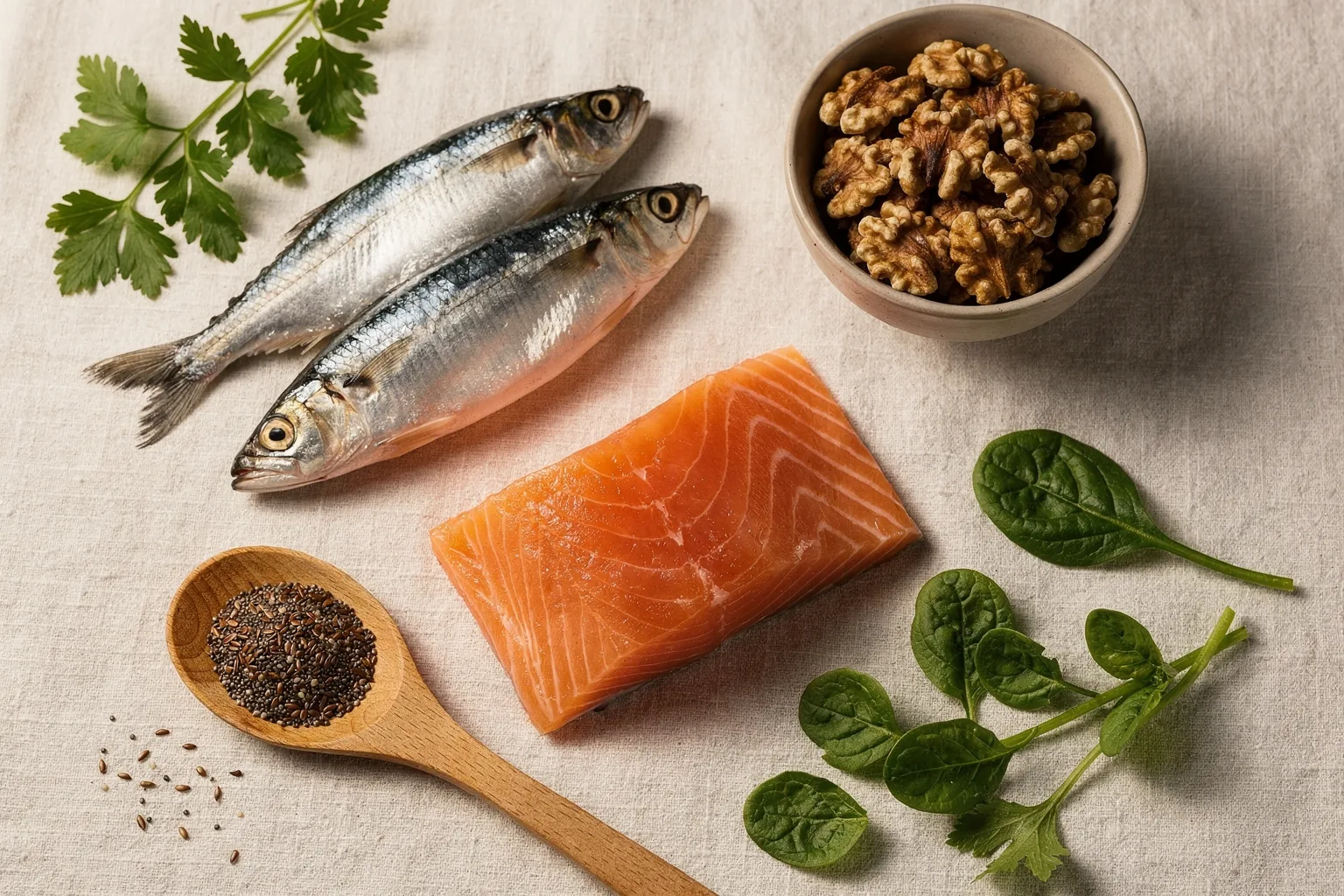
Omega-3 fats — mainly EPA and DHA from oily fish — support normal heart and brain function, and play a role in the low-grade inflammation that builds with age. But omega-3 is not a stimulant. There is no good evidence that fish oil ‘boosts’ energy in someone who already gets enough, and the clearest healthy-ageing benefits come from eating fish, not from a capsule.
Fish oil is one of the world’s most-bought supplements, and the marketing around it promises energy, sharper thinking and a longer life. The honest picture is more nuanced and more useful: omega-3 is an essential nutrient with a few well-supported roles, several oversold ones, and a quiet gap between what eating fish does and what swallowing a capsule does. This page grades that evidence plainly.
This is one spoke of a bigger picture. Omega-3 is one of the foundational nutrients behind everyday energy, so if you arrived here wondering whether to add a supplement, start with the parent guide on foundational nutrient status, which sits under the pillar why am I always tired? — because a single nutrient rarely explains tiredness on its own.
- EPA and DHA are the forms that matter, and they come mainly from oily fish; the plant form (ALA) is a building block your body uses slowly.
- ALA converts poorly — only about 5–10% to EPA and 2–5% to DHA, so flax and chia cannot fully replace fish.
- It is not an energy stimulant. Omega-3’s documented roles, per the Harvard T.H. Chan School of Public Health, are for the heart and brain — not a ‘reduces tiredness’ role like iron, B12 or magnesium.
- For a healthy general population, eating fish beats a pill. Large supplement trials such as VITAL were underwhelming.
- It is safe at sensible doses — up to 5 g a day of EPA and DHA raises no safety concern for adults — but supplement freshness and blood-thinning medicines are worth checking.
What is omega-3, and what is the difference between EPA, DHA and ALA?
Omega-3 is a family of essential fats your body cannot make in useful amounts, so you have to eat them. Three forms matter: ALA, which is plant-based, and the two long-chain forms EPA and DHA, which are the biologically active ones found mainly in oily fish and seafood.
The sources split cleanly. According to the Harvard T.H. Chan School of Public Health, EPA and DHA come mainly from cold-water fish, while ALA is found in plant oils such as canola, soybean and flax, in walnuts, and in chia and flax seeds. The catch is the conversion. Your body can turn ALA into EPA and DHA, but a review of omega-3 metabolism describes this as a highly inefficient process, with only about 5–10% of ALA converted to EPA and 2–5% to DHA in healthy adults. In plain terms: a handful of walnuts or a spoon of flax is good food, but you cannot rely on it to reach useful DHA levels. Oily fish is the direct route, and for people who do not eat fish, an algae-derived EPA/DHA is the vegetarian equivalent. This is exactly the kind of detail that separates omega-3 from the other foundational nutrients behind energy.
Does omega-3 actually boost energy and beat tiredness?
Not directly. Omega-3 is not a stimulant, and there is no strong evidence it lifts energy in a well-nourished person. Unlike iron, vitamin B12 and magnesium — nutrients with recognised roles in reducing tiredness and fatigue — omega-3’s recognised roles, as summarised by the Harvard T.H. Chan School of Public Health, are about the heart and brain, not fatigue. Any effect on how you feel tends to be indirect, and clearest in people who are genuinely short.
It helps to be precise about the claim. Fish oil will not give you a lift the way caffeine does, and the energy people notice after eating more fish often comes from the meal as a whole — more protein and fewer ultra-processed foods — rather than from omega-3 acting like a tonic. So if your tiredness is new or heavy, the honest first move is to check the common, fixable drivers: the everyday causes we map in iron, B12 and vitamin D and fatigue and in the main guide, why am I always tired?, are far more likely to explain it than a missing capsule.
What does omega-3 really do for healthy ageing — the brain, heart and inflammation?
The healthy-ageing case is strongest for the brain and the heart, with one important caveat: the benefit shows up most when omega-3 comes from a fish-rich diet, not from supplements taken once problems have started. It supports normal function rather than treating any condition.
Does omega-3 protect the ageing brain?
DHA is the most abundant fatty acid in the brain, according to the Harvard T.H. Chan School of Public Health — a structural fat the brain and the retina are literally built from — which is why interest in DHA and the ageing brain is reasonable. But topping up with capsules once memory has started to slip is underwhelming. The 2023 CANN trial gave older adults with mild cognitive complaints 1.1 g of DHA and 0.4 g of EPA a day for a year, alongside cocoa flavanols, and concluded the supplements did not improve cognitive outcomes in those with cognitive impairment. The honest reading: build the dietary pattern early, and do not expect a capsule to undo decline.
Does an omega-3 supplement protect the heart?
This is where the gap between food and pills is widest. In population studies, people who eat oily fish weekly tend to have better heart health; taking fish-oil capsules, in large trials, mostly does not reproduce that. The landmark VITAL trial randomised about 25,000 healthy US adults to 1 g a day of marine omega-3, and its conclusion was blunt.
Supplementation with n−3 fatty acids did not result in a lower incidence of major cardiovascular events or cancer than placebo. VITAL trial, New England Journal of Medicine, 2019
Does omega-3 help with inflammation as we age?
Where omega-3 has gentler, more consistent support is the low-grade inflammation that tends to rise with age — the same wear-and-balance story we tell in oxidative stress, explained and antioxidants, energy and ageing. EPA and DHA are building blocks the body draws on in its normal inflammation-balancing processes. That is a supporting role in normal function, not a remedy — and it is one more reason the food-first approach, where omega-3 arrives alongside protein and other nutrients, tends to win.
Malaysia eats a lot of fish — so why might omega-3 still fall short?
Malaysians are among the world’s biggest fish eaters, yet the omega-3 you actually get depends on which fish you choose and how it is cooked — and the national favourite, deep-frying, can tilt the balance the wrong way.
The intake is genuinely high. A study of adults across Peninsular Malaysia found people ate 168 g of fish a day on average — one of the highest intakes in Asia, ranking third after Japan and South Korea for per-capita fish consumption, with Malay adults eating the most (175 g/day) compared with Chinese (152 g/day) and Indian (136 g/day) adults. On paper, that is a strong omega-3 platform.
But intake is not the whole story, because cooking changes the fat you end up eating. The same Malaysian survey found the most popular preparation by far was deep-fried fish, and frying matters. In one analysis, frying lean fish in vegetable oil pushed the omega-6 to omega-3 ratio from 0.08 in raw cod up to 6.63 when fried in sunflower oil — the fish soaks up omega-6-rich frying oil and the favourable balance is lost. Oily fish such as salmon, sardines and mackerel hold their omega-3 far better than lean white fish. So the practical, very Malaysian takeaway is encouraging but specific: eating fish often is a real advantage — but a steamed, baked or grilled oily fish does much more for your omega-3 than a deep-fried lean one.
How much omega-3 do I need, and is food better than a supplement?
For most people the simplest target is dietary, not a dose off a label: the UK NHS advises at least two portions of fish a week, including one of oily fish such as salmon, sardines or mackerel. For a healthy general population, food beats a pill — a supplement makes the most sense for people who genuinely do not, or cannot, eat fish.
The reason to lead with food rather than capsules is that the trial evidence points that way. Harvard’s nutrition reviewers note that eating fatty fish weekly is well supported, yet many large clinical trials have not shown that omega-3 supplements provide the same protection. Whole fish brings protein, selenium, iodine and vitamin D along with its omega-3; a capsule brings only the oil. The table below sorts the popular claims from the supported ones.
| The popular claim | What the evidence actually supports |
|---|---|
| ‘Fish oil gives you an energy boost.’ | No — it is not a stimulant. Any effect on how you feel is indirect, and mainly in people who are genuinely short. |
| ‘A supplement protects a healthy heart just like eating fish.’ | Mostly no — large trials in healthy adults, such as VITAL, found no reduction in major events. |
| ‘Plant omega-3 (flax, chia) is as good as fish.’ | Limited — ALA converts poorly to EPA and DHA (about 5–10% and 2–5%). |
| ‘More is always better.’ | No — benefits plateau, and very high doses are for specific medical situations under guidance, not everyday use. |
| ‘All fish-oil capsules are the same.’ | No — independent testing finds many are oxidised (rancid); freshness and the EPA/DHA dose on the label both matter. |
So who might reasonably take a supplement? People who eat little or no oily fish; vegetarians and vegans, for whom an algae-based EPA/DHA is the practical source; and some life stages such as pregnancy, with professional guidance. This is the same ‘check before you buy’ logic we apply to whether a multivitamin is worth it — match the supplement to a real gap, rather than taking it on faith.
Is omega-3 safe, and what should I check before buying a supplement?
For most healthy adults omega-3 is very safe at sensible doses. European food-safety assessors concluded that supplemental EPA and DHA combined at up to 5 g a day do not raise safety concerns for adults, including no increased risk of bleeding at those doses. The more practical issues are medicine interactions and supplement quality.
On interactions: even though routine doses did not raise bleeding risk in that assessment, high-dose fish oil can have a mild blood-thinning effect, so anyone taking blood-thinning medication such as warfarin, or preparing for surgery, should check with a doctor or pharmacist first. On quality, the quieter problem is freshness. Omega-3 fats oxidise easily, and independent testing has repeatedly found a sizeable share of supplements past recommended freshness limits: a review pooling four studies of 260 products reported around half of Canadian products exceeding at least one oxidation measure, and more than 80% in some South African and New Zealand samples. The same authors are careful to add that the health consequences of consuming oxidised fish oil are not yet established — so this is a value-and-quality point, not a scare. A capsule that smells strongly fishy or rancid is past its best.
What this tends to mean in practice: eat oily fish a couple of times a week, cook it gently more often than you fry it, and treat a supplement as a sensible top-up if fish is genuinely missing from your plate — choosing a fresh, well-stored product and checking it against any medication you take. Whether you personally need one depends on your diet, your stage of life and what else is going on, which is exactly the kind of question a calm, no-pressure chat can help you think through.
Frequently asked questions
Does fish oil give you energy?
No, not the way a stimulant does. Omega-3 is not caffeine and you will not feel a lift from it. Its recognised roles are for the heart and brain, not for reducing tiredness, and there is no strong evidence it raises energy in someone who is already well-nourished. If you feel persistently tired, the more likely causes — iron, vitamin B12 and vitamin D status among them — are worth checking with a blood test and a healthcare professional.
Is it better to eat fish or take a fish-oil supplement?
For a healthy general population, food first. The NHS advises at least two portions of fish a week, including one of oily fish, and whole fish brings protein and other nutrients a capsule does not. Large supplement trials have generally been underwhelming. A supplement makes the most sense for people who do not, or cannot, eat fish.
Can I get enough omega-3 from flaxseed or chia if I do not eat fish?
Only partly. Plant foods provide ALA, which your body converts to the active forms EPA and DHA very inefficiently — about 5–10% to EPA and 2–5% to DHA. Flax, chia and walnuts are still healthy foods, but if you do not eat fish, an algae-derived EPA/DHA is the more reliable way to reach useful long-chain omega-3 levels. Ask a healthcare professional about your own situation.
Does deep-frying fish destroy the omega-3?
Frying changes the balance more than it simply destroys omega-3. In one analysis, frying lean fish in vegetable oil pushed the omega-6 to omega-3 ratio from 0.08 in raw cod to 6.63 fried in sunflower oil, because the fish soaks up omega-6-rich oil. Oily fish hold their omega-3 better than lean fish, and steaming, baking or grilling preserves more than deep-frying — a useful point given how popular fried fish is in Malaysia.
How much fish oil is safe, and who should be careful?
European food-safety assessors concluded that up to 5 g a day of EPA and DHA combined raises no safety concern for adults. Even so, high-dose fish oil can mildly thin the blood, so anyone on blood-thinning medication or facing surgery should check with a doctor or pharmacist first. It is also worth choosing a fresh product, since independent testing finds many supplements are oxidised.
References
- Fish consumption pattern among adults of different ethnics in Peninsular Malaysia (Food & Nutrition Research, 2016) — mean intake 168 g/day; Malay 175, Chinese 152, Indian 136 g/day; Malaysia ranked third in per-capita fish consumption after Japan and South Korea; deep-fried was the most preferred preparation.
- Are all n-3 polyunsaturated fatty acids created equal? (review of omega-3 metabolism) — ALA-to-EPA/DHA conversion is a highly inefficient process; only about 5–10% of ALA is converted to EPA and 2–5% to DHA in healthy adults.
- Marine n-3 Fatty Acids and Prevention of Cardiovascular Disease and Cancer — the VITAL trial (New England Journal of Medicine, 2019) — 1 g/day marine omega-3 in ~25,000 healthy adults did not lower major cardiovascular events or cancer versus placebo.
- DHA-rich fish oil and cocoa flavanols in older adults with memory complaints — the CANN trial (American Journal of Clinical Nutrition, 2023) — 1.1 g DHA + 0.4 g EPA/day for 12 months did not improve cognition in those with cognitive impairment.
- EFSA assesses safety of long-chain omega-3 fatty acids (European Food Safety Authority) — supplemental EPA and DHA combined at up to 5 g/day do not raise safety concerns for adults, with no increased bleeding risk at those doses.
- Fishing for answers: is oxidation of fish oil supplements a problem? (review) — across four studies of 260 products, around half of Canadian and more than 80% of some South African and New Zealand supplements exceeded recommended oxidation limits; health consequences of oxidised oil are not yet established.
- Fish and shellfish (UK NHS) — eat at least two portions of fish a week, including one of oily fish (salmon, sardines, mackerel); oily fish is high in long-chain omega-3.
- Omega-3 Fatty Acids (Harvard T.H. Chan School of Public Health, The Nutrition Source) — EPA/DHA from cold-water fish, ALA from plants; DHA is the most abundant fatty acid in the brain; supplements have often not matched the protection seen from eating fish.
- Effect of fish and oil nature on frying process and nutritional product quality (2010) — frying lean fish in vegetable oil raised the omega-6 to omega-3 ratio from 0.08 (raw cod) to 6.63 (fried in sunflower oil).