On this page
- What is "iron deficiency without anaemia," and how is it different from anaemia?
- What ferritin level counts as "low" — and why can inflammation hide it?
- What does iron deficiency without anaemia actually feel like?
- Does correcting it actually reduce fatigue, or is this just theory?
- How common is this in Malaysia, and why?
- Food first: which foods, and how tea gets in the way
- Should you test before you start an iron supplement?
Yes. "Iron deficiency without anaemia" (IDWA) means your iron stores, measured by ferritin, are running low even though your haemoglobin is still in the normal range — so a standard blood test can look fine while you still feel drained. A randomised trial found fatigue genuinely improved when this was corrected, and IDWA is thought to be at least twice as common as full iron-deficiency anaemia.
This page sits in our cluster on foundational nutrients, under the pillar guide why am I always tired? It is a close cousin of our overview on iron, B12 and vitamin D, but zooms in on one specific, under-discussed nuance: the gap between "my iron stores are low" and "my blood test came back normal." Those are not the same statement, and the difference explains a lot of unexplained tiredness.
- IDWA is common and under-recognised. It is estimated to be at least twice as common as full iron-deficiency anaemia, but a normal haemoglobin means it is often never even tested for.
- Ferritin below roughly 30 µg/L is the usual threshold. Below that level, iron stores are considered depleted even when red blood cells still look normal on a standard count.
- Inflammation can hide a real deficiency. Ferritin rises during illness or inflammation, so doctors switch to a higher cut-off plus a second marker, transferrin saturation, when you are unwell.
- Correcting it measurably reduces fatigue. A 12-week randomised trial in non-anaemic women with low ferritin found iron supplementation cut fatigue scores by 47.7%, against 28.8% on placebo.
- It is a real Malaysian concern, especially for women. National data puts anaemia at 25.5% in Malaysian women versus 5.5% in men, and average iron intake sits below the recommended level.
What is "iron deficiency without anaemia," and how is it different from anaemia?
Iron deficiency without anaemia (IDWA) is when your body's iron stores are depleted — shown by a low ferritin level — but your haemoglobin, the standard anaemia measure, is still within the normal range. Anaemia is the later stage, once iron has run so low that red blood cell production itself is affected. IDWA is the earlier, far more common stage that routine screening often misses entirely.
A 2021 review in Clinical Medicine put it plainly: iron deficiency is "a broader term" than anaemia, referring to depleted iron stores "regardless of whether anaemia is present or not." Iron-deficiency anaemia (IDA) alone is estimated to affect around 1.2 billion people worldwide, and the same review estimates IDWA is at least twice as common again — meaning the population walking around with genuinely low iron, but a haemoglobin result that reads "normal," is larger than the population with diagnosed anaemia. The reason it is missed is structural: a routine full blood count reports haemoglobin by default, not ferritin, so unless a doctor specifically orders an iron panel, IDWA stays invisible on paper even while it is producing real symptoms.
What ferritin level counts as "low" — and why can inflammation hide it?
In someone without active inflammation, a ferritin under roughly 30 µg/L is generally treated as a sensitive marker of depleted iron stores. But ferritin is also an "acute-phase" protein that rises during infection, illness or inflammation — so the same "normal" number can mask a true deficiency, and clinicians then switch to a higher cut-off (under about 100 µg/L) plus a second marker, transferrin saturation under 20%.
The mechanism is worth understanding because it explains why "my ferritin was fine" is not always the reassurance it sounds like. Inflammatory cytokines, particularly interleukin-6, trigger the liver to raise hepcidin, the hormone that controls iron traffic in the body. Hepcidin binds to the iron-exporting protein ferroportin and marks it for breakdown, which traps iron inside storage cells — pushing serum ferritin up even as the iron actually available for red blood cells and energy production goes down. That is why the World Health Organization recommends checking inflammation markers such as CRP alongside ferritin whenever illness or a chronic condition is in the picture, rather than reading a single ferritin number in isolation.
Iron deficiency is a broader term and refers to low iron stores that do not meet the body's iron requirements, regardless of whether anaemia is present or not. Al-Naseem et al., Clinical Medicine, 2021
What does iron deficiency without anaemia actually feel like?
Beyond everyday tiredness, IDWA has been linked to reduced exercise capacity, restless legs syndrome, and pica — cravings for non-food items, most often ice. None of these is unique to low iron, which is exactly why they are easy to blame on stress, poor sleep or simply "getting older." A ferritin test, not guesswork, is what actually tells the two apart.
Restless legs syndrome is one of the better-studied links. A 2020 study in Frontiers in Neurology examined 196 people with restless legs syndrome who were not anaemic, and found that 42.3% of them had a genuine iron deficiency once ferritin and transferrin saturation were checked — and that share was far higher in women (58.5%) than men (10.6%). Pica, the craving for ice, chalk or starch, is a stranger but well-documented sign, thought to reflect the body's drive to seek out minerals when iron is short. None of this means every restless night or ice habit is about iron — but it is a reasonable prompt to ask for a ferritin test rather than assuming it is unrelated.
Does correcting it actually reduce fatigue, or is this just theory?
Yes, in the best-designed trial available. A 12-week randomised, double-blind, placebo-controlled study gave 198 non-anaemic menstruating women with low ferritin either 80 mg of elemental iron a day or a placebo. The iron group's fatigue scores fell by 47.7%, against 28.8% on placebo — a statistically significant gap (p=0.02), not just a placebo effect on both sides.
The trial, published in CMAJ in 2012, specifically enrolled women aged 18 to 53 with unexplained fatigue, a ferritin under 50 µg/L, and haemoglobin above 12.0 g/dL — a textbook IDWA profile, not anaemia. Over 12 weeks on prolonged-release ferrous sulfate, the iron group's mean fatigue score dropped by 12.2 points on a 40-point scale, versus 8.7 points for placebo. Both groups improved, which is a useful honesty check — some of any fatigue trial's result is expectation and time passing — but the iron group improved meaningfully more, and 80 mg a day is a substantial, prescription-strength dose, several times higher than a typical multivitamin's iron content.
How common is this in Malaysia, and why?
Anaemia — the visible, later-stage end of iron deficiency — affects roughly a quarter of Malaysian women, against about one in twenty men, according to the most recent nationwide data. Because IDWA runs well ahead of anaemia, the true share of Malaysian women with depleted iron stores but a still-normal blood count is almost certainly larger than the anaemia figures alone suggest.
A 2026 nationwide study published in BMC Public Health put overall anaemia prevalence among Malaysian adults at 15.0%, affecting an estimated 3.6 million people — but that figure splits sharply by sex: 25.5% in women against 5.5% in men, a gap driven mainly by menstrual iron loss. The same paper cites the Malaysian Adult Nutrition Survey finding that the population, on average, consumes only 78.4% of the recommended iron intake — a dietary shortfall wide enough that low ferritin is a plausible everyday reality for a large share of Malaysian women well before it shows up as anaemia on a blood test.
Food first: which foods, and how tea gets in the way
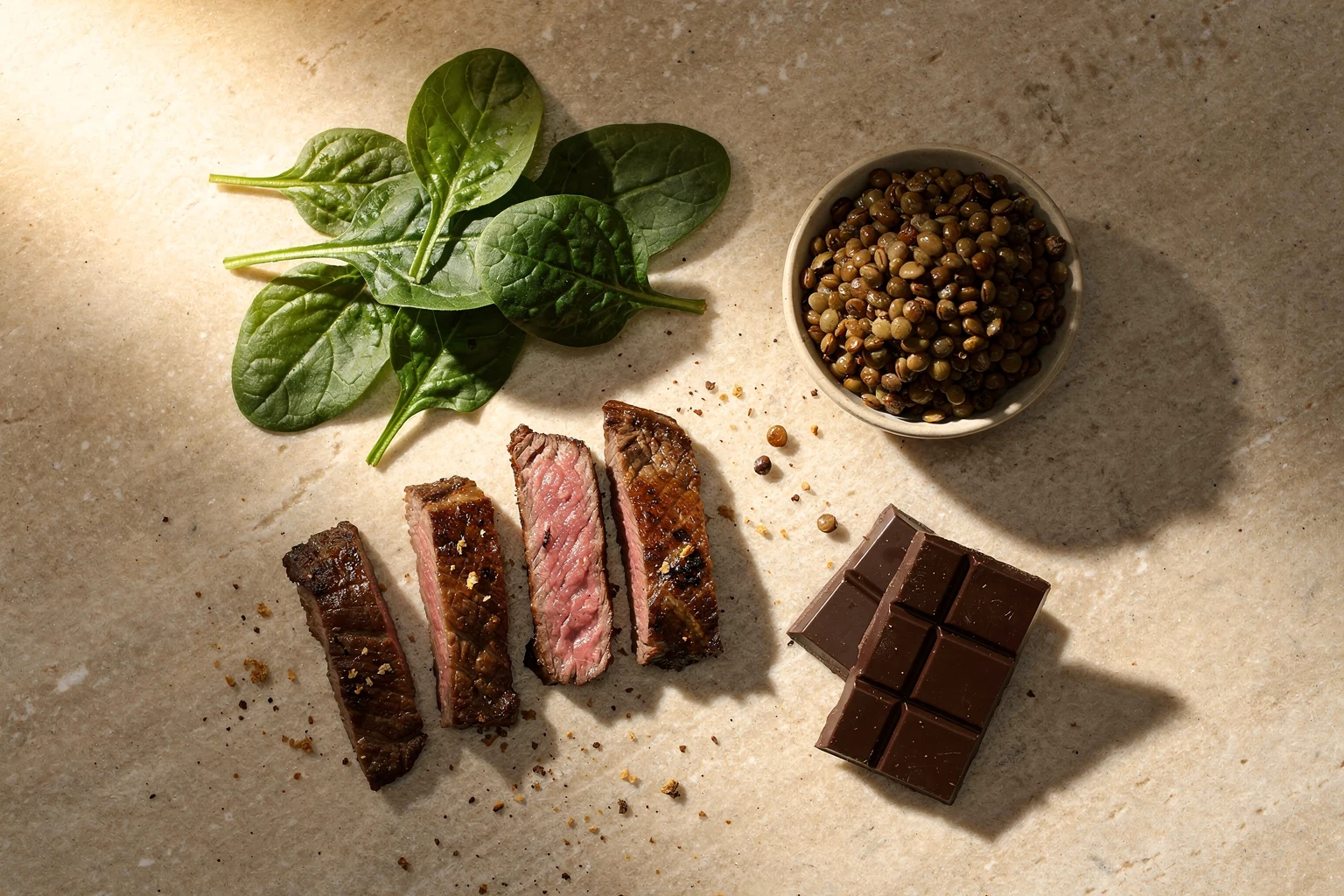
Iron from meat, poultry and fish ("haem" iron) is absorbed far more efficiently than the "non-haem" iron in beans, tofu and leafy greens. Pairing plant-based iron with a source of vitamin C improves absorption, while tea and coffee taken with a meal work the other way — their tannins bind iron into a form the gut struggles to use.
| Food | Serving | Iron |
|---|---|---|
| Oysters, cooked | 3 oz | 8 mg |
| White beans, canned | 1 cup | 8 mg |
| Beef liver, pan-fried | 3 oz | 5 mg |
| Lentils, boiled | ½ cup | 3 mg |
| Spinach, boiled | ½ cup | 3 mg |
| Tofu, firm | ½ cup | 3 mg |
| Dark chocolate (45–69% cacao) | 1 oz | 2 mg |
| Chickpeas, boiled | ½ cup | 2 mg |
A 1975 study in the journal Gut was one of the first to demonstrate the tea effect directly: tea inhibited iron absorption from bread, rice-based meals and iron solutions alike, through the formation of insoluble iron-tannate complexes in the gut, and the researchers concluded that tannin-containing beverages taken with a largely plant-based diet "may contribute to the pathogenesis of iron deficiency." That is a meaningful line for Malaysian households, where tea is often poured alongside rice-and-vegetable meals that are already leaning on non-haem iron. The fix is not giving up tea; it is timing. Having tea or coffee between meals rather than with them, and adding a squeeze of lime or a side of fruit to an iron-rich meal, helps protect the iron you are already eating.
Should you test before you start an iron supplement?
Yes — and this cuts both ways. Guessing wastes time if fatigue has another cause entirely, and starting an iron supplement without knowing your ferritin risks quietly overloading your iron stores, a genuine problem especially for men and women past menopause, who no longer lose iron the way a menstruating woman does.
Because iron is not easily excreted once absorbed, taking supplements without a documented need can build up over years, not days. Clinical guidance is explicit that people should "avoid unnecessary iron supplements and iron-containing multivitamins, especially when not clinically indicated," and flags men, postmenopausal women, and anyone with a family history of hereditary haemochromatosis as the groups who most need a blood test first, not a supplement first. If you do buy an iron product in Malaysia, the same checkpoint applies as for any supplement here: the National Pharmaceutical Regulatory Agency (NPRA) requires registered products to carry a MAL registration number on the label. A MAL number confirms the product is properly on the market; it does not confirm you personally need it. The sensible order is the one this whole page has been building toward: test, then eat with intention, and treat a supplement as a decision for after you know your number, not before.
If persistent fatigue, restless legs or unusual cravings are affecting your day-to-day life, that is worth a proper conversation rather than a guess in either direction — toward a supplement or away from one.
Frequently asked questions
What ferritin level is considered too low?
In someone without inflammation, a ferritin under roughly 30 µg/L is generally treated as the threshold for iron deficiency, with or without anaemia. If you have an infection, chronic illness or other inflammation, ferritin can be pushed artificially higher, so doctors instead look for ferritin under about 100 µg/L or a transferrin saturation below 20%. Reference ranges vary slightly between labs, so always read your result against the range printed on your own report.
Can you be iron deficient with a completely normal blood test?
Yes — this is exactly what "iron deficiency without anaemia" describes. A standard full blood count reports haemoglobin, which only falls once iron stores are seriously depleted. Ferritin, the marker of stored iron, is a separate test that is not always included by default, so someone can have a textbook-normal haemoglobin and still be iron deficient underneath it.
How long does it take for iron supplements to help with fatigue?
In the main randomised trial on this question, non-anaemic women with low ferritin taking 80 mg of iron a day saw their fatigue scores fall by 47.7% over 12 weeks, versus 28.8% on placebo. That points to weeks rather than days, and some of that improvement is likely a placebo effect on both sides — the meaningful gain was the roughly 19-percentage-point gap between the two groups.
Is it safe to start taking iron supplements without a blood test?
It is not the safest approach. Taking iron you may not need can build up in the body over time — a genuine risk for men, women past menopause, and anyone with a family history of haemochromatosis, none of whom lose iron the way a menstruating woman does. A simple blood test first tells you whether you actually need iron, and how much.
Does drinking tea cause iron deficiency?
Tea alone is unlikely to cause iron deficiency, but it can make a marginal iron intake worse. The tannins in tea and coffee bind to non-haem iron, the type found in plant foods, in the gut and reduce how much is absorbed. Having tea between meals rather than with them, and pairing iron-rich meals with a source of vitamin C, helps protect absorption.
What foods help raise low ferritin?
Oysters, white beans, beef liver, lentils, tofu and dark chocolate are among the more concentrated food sources of iron, per U.S. nutrition data. Iron from meat, poultry and fish is absorbed more efficiently than the iron in beans and greens, so pairing plant-based iron with vitamin C — citrus, capsicum, tomato — helps close that gap. Food first is the sensible starting point; a supplement is a decision for after testing, not before.
References
- Iron deficiency without anaemia: a diagnosis that matters (Al-Naseem et al., Clinical Medicine, 2021) — supports the IDWA definition, the ferritin under 30 µg/L threshold, and IDWA being at least twice as common as iron-deficiency anaemia (1.2 billion people worldwide).
- Effect of iron supplementation on fatigue in nonanemic menstruating women with low ferritin: a randomized controlled trial (Vaucher et al., CMAJ, 2012) — supports the 198-woman, 12-week, 80 mg/day RCT; fatigue scores fell 47.7% on iron vs 28.8% on placebo (p=0.02).
- The nationwide prevalence of anaemia and the associated factors in the general adult population in Malaysia (Wan et al., BMC Public Health, 2026) — supports Malaysia's 15.0% overall anaemia prevalence, 25.5% in women vs 5.5% in men, and the Malaysian Adult Nutrition Survey's 78.4%-of-recommended-intake figure.
- Limitations of Serum Ferritin in Diagnosing Iron Deficiency in Inflammatory Conditions (Dignass et al., International Journal of Chronic Diseases, 2018) — supports ferritin as an acute-phase protein raised by inflammation via IL-6/hepcidin, and the adjusted <100 µg/L / TSAT<20% threshold used with inflammation.
- Correlates of Nonanemic Iron Deficiency in Restless Legs Syndrome (Zhu et al., Frontiers in Neurology, 2020) — supports the 42.3% iron-deficiency rate among non-anaemic RLS patients, and the 58.5% women vs 10.6% men split.
- The effect of tea on iron absorption (Disler et al., Gut, 1975) — supports tea's inhibition of non-haem iron absorption via insoluble iron-tannate complexes, and the conclusion that tannin-containing beverages with a plant-heavy diet may contribute to iron deficiency.
- Dietary Iron (Moustarah & Daley, StatPearls, 2026) — supports the iron-content-per-serving figures for oysters, white beans, beef liver, lentils, spinach, tofu, dark chocolate and chickpeas.
- Iron Overload and Toxicity (Baddam & Chen, StatPearls, 2025) — supports the caution against unnecessary iron supplementation, and the postmenopausal-women vs men overload-screening ferritin thresholds.
- Product Registration FAQ (National Pharmaceutical Regulatory Agency, Malaysia) — supports that registered products must display a MAL registration number on the label.